The Matchless Match
Triple and quadruple entendres, and the search for the elusive quintuple

Matchmaker, matchmaker, plan me no plans
I’m in no rush, maybe I’ve learned
Playing with matches a girl can get burned
So bring me no ring, groom me no groom
Find me no find, catch me no catch
Unless he’s a matchless match
I’ve always enjoyed puns and other wordplay for their own sake, never needing any external justification or reward. But recently I came across Tomie’s tweet, which introduced me to a whole new world:
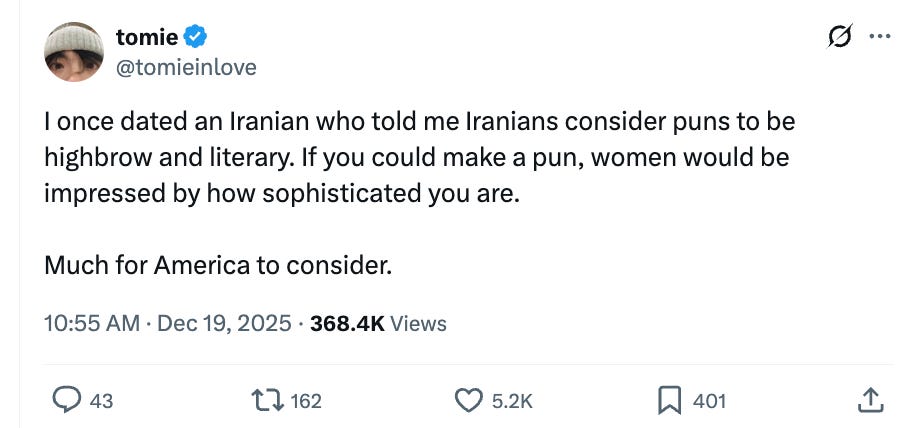
Elated, I immediately composed ten puns to court a Persian girl, hopeful that at least one example of my ingenious wordplay could win her over. Alas, no pun in ten did.
__
So where did I go wrong? Upon much care and reflection, I realized my mistake! Sophistication, I realized, couldn’t be signaled through mere double entendres. No, I needed something better to showcase my erudition, literary wit, and romantic suitability.
I needed, in short, to come up with triple entendres. Quadruple entendres. Or even (gasp!) quintuple entendres.
With this realization in mind, I set out to find existing examples of quintuple entendres out there, hoping to bolster my own efforts by learning from the greats. But I was shocked! Did you know that I couldn’t find a single legitimate and non-forced example of a quintuple entendre in English literature? Worse, nobody else has even created a cross-genre list of triple or quadruple entendres in English!
Undeterred, I compiled my own list of triple and quadruple entendres, for my own edification and your enjoyment1. To keep the list manageable, I used a fairly strict definition of triple entendre, something like:
Triple entendre(n): A word or phrase with three semantically distinct meanings that all function simultaneously in context. Not just three puns in sequence, and not a double entendre where one meaning happens to have two spellings. Further, they should be conceptually and semantically related to the overall theme of the work in question, not merely a great pun for its own reword.
At the very end, I appended my own entries to the canon. Enjoy!
Quadruple entendres
J Cole’s “flipped” in The Climb Back
Check out my projects like them workers that Section 8 appoints
And you’ll see how I flipped, like exclamation points
J Cole, The Climb Back
Rap has the highest lyrical complexity and wordplay of any popular English-language music genre. And triple/quadruple entendres are no exception.
In this case, “flipped” has at least four contextually relevant meanings in this rap song. You can watch this video dissecting it:
Prince’s “you got the horn, so why don’t you blow it” in Cream
Do your dance
Why should you wait any longer?
Take your chance
It could only make you stronger
It’s your time (It’s your time)
You got the horn, so why don’t you blow it?
Prince, Cream
The context of the funk rock song is Prince hyping himself up for success before a big (music?) event. In context, then, “You got the horn, so why don’t you blow it?” has four different meanings. The first is the literal: he has the musical horn, so why doesn’t he blow (play) it? The second meaning people usually get is the sexual: horn as slang for penis, blow as in blowjob2. The third meaning is bragging: to blow (tout) your own horn, which is probably the most central/contextually relevant to the song itself. The final meaning is displaying self-doubt and insecurity: to “blow it,” as in to fail utterly at your big chance.
Possessed Machines
As I was researching this blog, my friend showed me this title of an anonymous essay by an ex-AI frontier company employee using literary criticism of Dostoevsky’s Demons, of all things, to analyze AI development.
First, AIs as machines we possess: own, control, have as property. Second, machines that are possessed in the supernatural sense: inhabited by something alien to their original design. Systems “possessed” by emergent goals, mesa-optimizers, optimization targets that weren’t intended. Third, the builders are the possessed ones. Think: “Sam Altman as a machine possessed.” The essay’s central argument is that AI researchers are possessed in Dostoevsky’s sense: by cleverness divorced from wisdom, by the intoxication of capability, by “the spirit of acceleration itself.”
Finally, machines that will possess us.
The title also alludes to the alternate English translation of Dostoevsky’s Бесы: The Possessed.
Triple Entendres
Rap examples
“Lucy” in Kendrick Lamar’s For Sale
Lucy give you no worries, Lucy got million stories
About these rappers that I came after when they was boring
Lucy gon’ fill your pockets
Lucy gon’ move your mama out of Compton
Inside the gi-gantic mansion like I promised
Lucy just want your trust and loyalty, avoiding me?
…
All your life I watched you
And now you all grown up to sign this contract, if that’s possible
I can’t find a single line or stanza to do it justice, but the entire song is about Kendrick Lamar being tempted by a woman named Lucy who tempts him with money, fame, drugs, and sex, if only he just “signs a contract”.
“Lucy” could also be short for Lucian Charles Grainge, CEO of Universal Music Group and often considered the most powerful man in the music industry. In that context, the contract is quite literal and represents sacrificing Kendrick’s artistic merit and truth for money and fame.
Finally “Lucy” could of course be short for Lucifer, and the contract referring to Kendrick signing away his soul.
“Little pricks” in Eminem’s Won’t Back Down
You’re addicted, I’m dope
I’m the longest needle around here—need a fix, ock?
I’m the big shot—get it, dick-snots?
You’re just small pokes, little pricks
Eminem, Won’t Back Down
This one is fairly self-explanatory. Eminem analogizes himself to being the biggest baddest drug represented by the biggest baddest needle. He calls his rivals “little pricks” as in a) very small drug insertions, b) generic insult (aka “small fuckers”), and c) literally insulting their tiny penises.
“Only way I begin to G off was drug loot” in Wu Tang Clan’s C.R.E.A.M
To begin to “G off” in Wu Tang Clan’s C.R.E.A.M3 has 3 different meanings: a) to “get off” (orgasm, whether literally or figuratively), b) to become a “G” (gangsta), and c) to make G’s (earn thousands of dollars).
There are other examples of triple entendres in rap, however I believe y’all will appreciate me branching outside of rap to showcase the fuller strength and breadth of triple entendres.
For people who want more examples of triple entendres in rap, Realers12 has a longer list and analysis of triple entendres in rap on WordPress(.com), including contested examples. Written in 2011, it has this charming, quaint, line, “The triple entendres is an elusive-ass motherf**ker. Some scholars say it does not exist! — they claim alleged triple entendres are usually just misunderstood homophones.”
Pun scholarship has surely advanced in the last 15 years! (And I’m glad to advance it further).
Other music
Moving Pictures
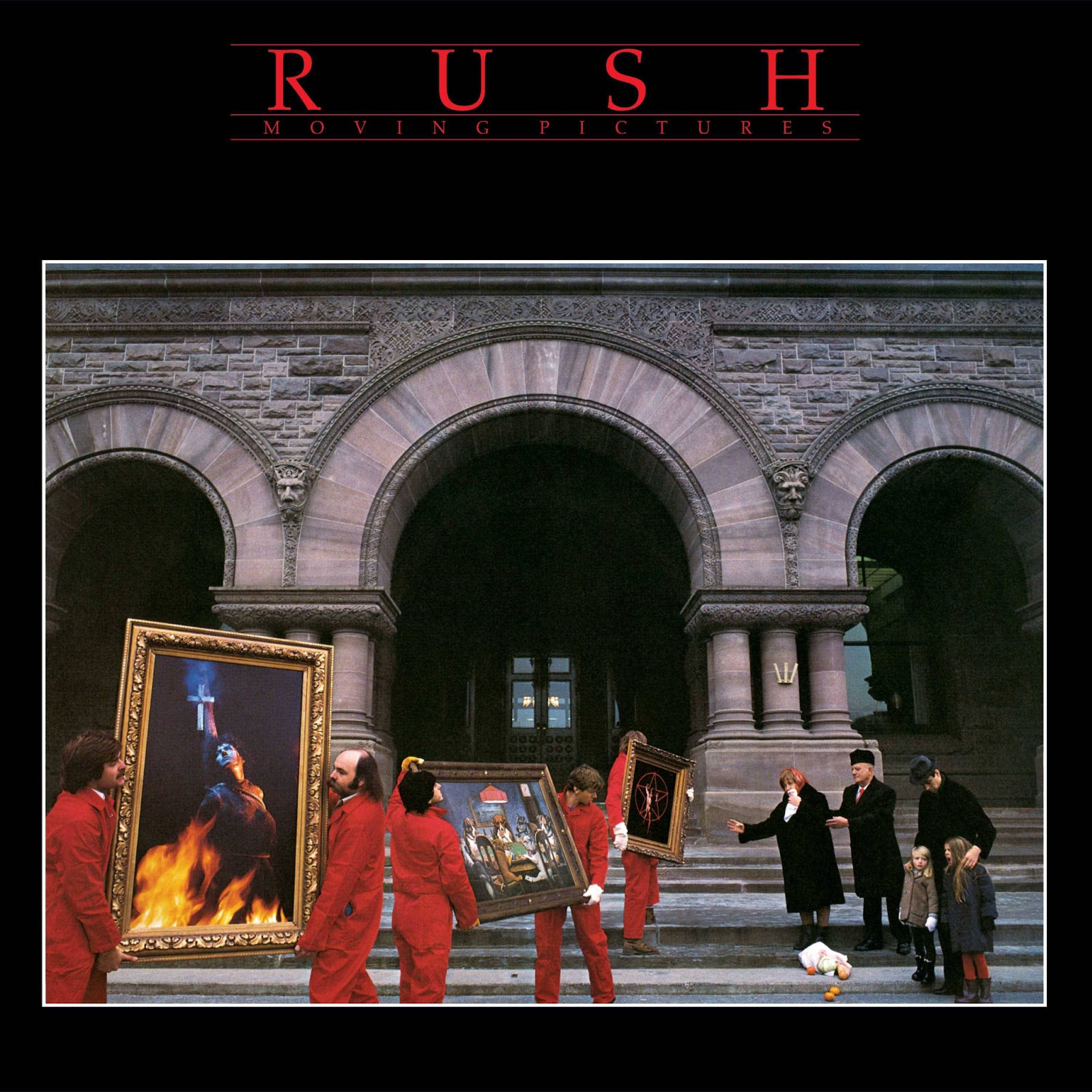
The eighth album by the Canadian rock band is called “Moving Pictures.” This is a triple entendre, which the album art makes explicit. Wikipedia: “the front depicts movers who are carrying pictures. On the side, people are shown crying because the pictures passing by are emotionally “moving”. Finally, the back cover has a film crew making a motion (moving) picture of the whole scene.”
Fiddler on the roof’s “Matchless match”
Matchmaker, matchmaker, plan me no plans
I’m in no rush, maybe I’ve learned
Playing with matches a girl can get burned
So bring me no ring, groom me no groom
Find me no find, catch me no catch
Unless he’s a matchless match
From Matchmaker in Fiddler on the roof
Our eponymous triple entendre comes from Fiddler on the Roof’s “Matchless match”:
“Matchless match” has 3 quite distinct meanings here:
“Matchless” in the sense of currently unpartnered. She’s matchless, and that’s why she needs a matchmaker.
“Matchless” in the sense of not being a powder keg/emotionally dangerous: “playing with matches a girl can get burned.” She wants someone safe.
“Matchless” in the sense of unparalleled. She wants the matchmaker to bring her the matchless match, the best match that no others could rival.
As an unmatched man bereft of the affections of my Persian crush, naturally this song spoke to me, as I too would like to find my own matchless match.

Hamilton: My Shot
“We’re gonna rise up, time to take a shot (I am not throwin’ away my shot)
We’re gonna rise up, time to take a shot (I am not throwin’ away my shot)
We’re gonna, rise up, rise up (it’s time to take a shot)
Rise up, rise up (it’s time to take a shot)”
From Hamilton, My Shot
“My shot” has three meanings:
“Shots” as in drinks: Hamilton et. al were literally at a bar.
“My shot” as in your opportunity. To not throw away my shot means to not give up my chance at fame/fortune/career success/American independence etc.
“Shots” as in a bullet shot.
The final meaning foreshadows the end of the play, as (SPOILERS for both the musical and for American history) “throwing away [your] shot” in dueling means to waste a shot in a duel by firing in the air, aka deloping. This is how the play ends: Hamilton intentionally throwing away his shot where Burr fired true, killing Hamilton.
Hamilton, having maintained throughout the play that he will not throw away his shot, decided at the very end to throw away his shot in his duel against Burr. Burr did not reciprocate or reasonably anticipate Hamilton’s decision, which in retrospect may have been a theory of mind failure on Hamilton’s end.
Non-music
Tailes from Chaucer
The first known example of a triple entendre comes from Geoffrey Chaucer’s Canterbury Tales, in the 1300s!
The Shipman’s Tale from Chaucer’s Canterbury Tales (c. 1380s) goes like this: A wealthy merchant’s wife complains to his close friend, a handsome monk named Dan John, that she needs 100 francs to pay a clothing debt. Dan John offers the money in exchange for sex, then borrows 100 francs from the merchant himself. While the merchant is away, Dan John gives the wife the borrowed money and sleeps with her. When the merchant returns, the monk mentions he’s already repaid the loan to the wife.
When confronted about this, the wife replies that she already spent the money and adds:
Y am youre wyf; score it upon my taille.
In old English, taille can mean any of tally/tale/tail. This thus have 3 different interpretations, all consistent:
I am your wife, add the score to my tally: We’re related, just add it to my tab! An accounting terminology/joke.
I am your wife, add it to my tale: It’s a fun story, isn’t it? Let’s make sure to include it in the Canterbury tales!
I am your wife, just score it on my tail: “Tail” as a euphemism for “pussy” apparently has a long and storied tradition.
To make sure the audience didn’t miss the pun, Chaucer reprises the triple pun again, ending the Shipman’s Tale thus:
Thus endeth my tale, and God us sende
Taillynge ynough unto oure lyves ende. Amen
This ends my tale, and God sends us:
[tallying/tale-ing/tailing] enough until our lives end.
The three meanings (accounting, storytelling, and banging) all work, in context. A sophisticated literary masterpiece of Ye Olde English.
Arrested Development
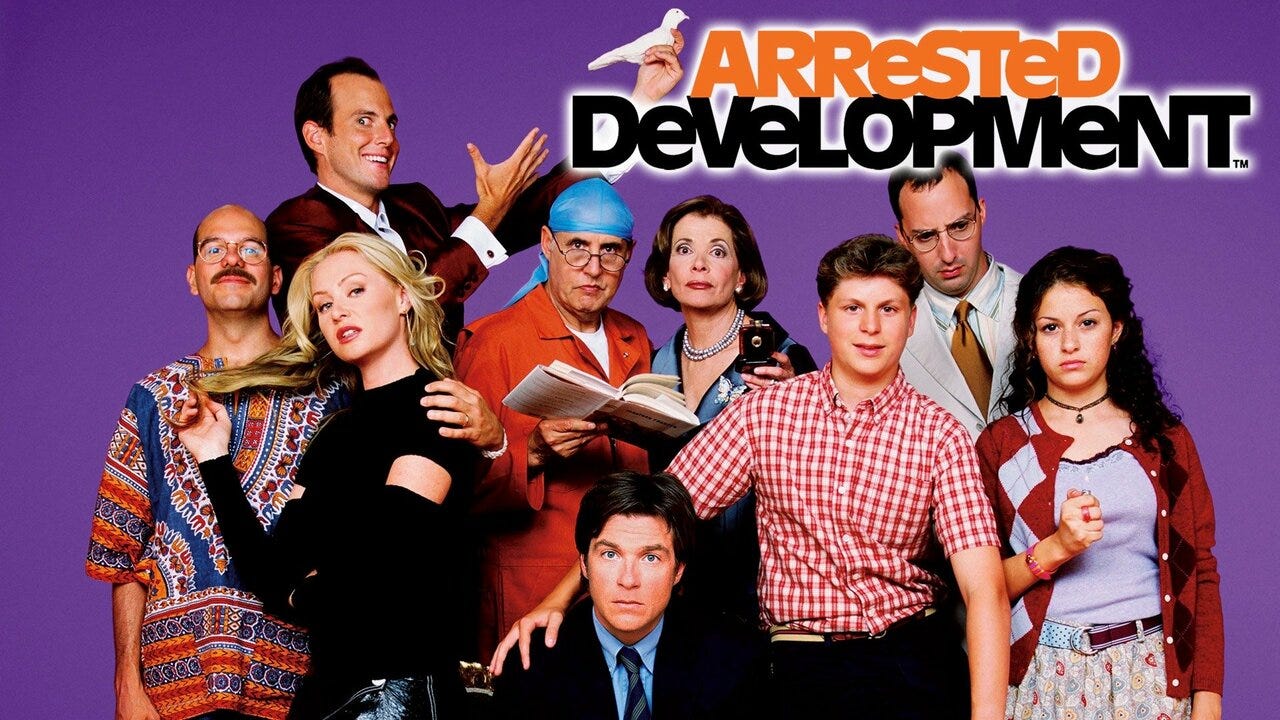
Arrested Development is a critically acclaimed sitcom about a wealthy but dysfunctional family of building developers whose lives were turned upside down when their patriarch was arrested for fraud.
The title itself is a triple entendre: “Arrested Development” has three contextually relevant meanings:
“arrested development” as a medical term for permanent childhood or mental retardation, indicating that the characters are manchildren (and womanchildren?) unable to develop and resisting growth.
Quite literally, they are developers who are arrested. Hence, “arrested development.”
The development projects seem to never go anywhere, so taking “arrested” to mean “stopped”, the sitcom is about the consequences of arrested building development.
Round the Horne
Round the Horne is a BBC comedy podcast from the 1960s. Starring Kenneth Horne, it likewise has a fairly straightforward triple-entendre title (left as an exercise to the reader).
Shakespeare’s Sun of York
Now is the winter of our discontent
Made glorious summer by this sun of York
William Shakespeare, Richard III
Shakespeare is a lyrical wordsmith, and famous lover of puns.
Here, “Sun of York” has 3 distinct meanings:
Metaphorically, the war of the Roses ends with the glorious sunny summer
The “Sun of York” as the heraldry of York.
A pun on “Son” of York: As the eldest son of the Duke of York, Edward is literally a “son of York”.
Of course, the line between “genuine triple entendre” and “clever wordplay that doesn’t quite cohere” can be blurry. The next section includes examples that I considered but ultimately rejected.

Rejected (though interesting)
6:16 in LA
Kendrick’s a great rapper, and known for lyrical complexity. Nonetheless, his fans sometimes overclaim his merits. For example, when I searched online for quintuple entendres, the title of his song dissing Drake, 6:16 in LA often comes up. For example, this guide by Bandini claims 5 distinct meanings:
Father’s Day 2024 Falls On June 16 (6/16): Kendrick disses Drake’s ability as a father, calling him a deadbeat dad.
June 16, 1994 as Funeral for Nicole Brown Simpson: Relevant in the song
Proverbs 6:16: “There are six things the Lord hates” Kendrick lists 6 things he hates about Drake
[As well as two other meanings that I thought were less interesting]
Indeed, Redditors online have discovered as many as 11 possible (and relevant!) meanings of 6:16. Some examples:
Drake calling himself 6 god and his links with 16 year olds. Kendrick has often accused Drake of pedophilia
OJ Simpson trial start date
Nonetheless, while clever, I ultimately don’t think it counts as a true quintuple (or higher) entendre. This is more of a judgment call, but I think it’s much easier to do numerical collisions (numerology) than word collisions. So while interesting, I don’t think a number that that 5+ distinct and relevant meanings is enough to count as a N-tuple entendre.
“Will” from Shakespeare’s Sonnet 135
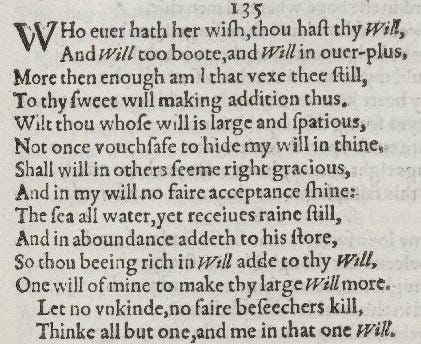
Like Kendrick Lamar, William Shakespeare is a great wordsmith (possibly the best battle rapper of his time), and known for a highly devoted and obsessive fanbase. While he has legitimate triple entendres like the “Son of York,” his fans often overclaim. For example, in Shakespeare’s Sonnet 135, Shakespeare stans like Professor Stephen Booth noted that “Will” has as many as 6 distinct meanings:
what one wishes to have or do
the auxiliary verb indicating futurity and/or purpose
lust, carnal desire
the male sex organ
the female sex organ
an abbreviation of “William”
So is this a sextuple (ha!) entendre? I think not. Firstly, “Will” is repeated throughout the text, and there aren’t many (any?) instances where an individual occurrence of “will” has 3 meanings. Secondly, I’m not convinced that the first meaning (what one wishes to do, eg “my will is”) is contextually distinct from the third meaning (lust, eg “I will for her”). Thirdly, I haven’t seen any documented evidence that “Will” has previously been used to mean genitalia (of either sex) before Shakespeare, so until I do, I wouldn’t count 4 or 5 as a distinct pun. If I say, “I want to put my desire in your desire”, I think the meaning is contextually obvious, but I would not consider it a double entendre, never mind a triple entendre. This is because you can’t redefine a word and then just call it a pun.
Similarly, many other claims of triple+ entendres from Shakespeare feels like an overreach, like “Country Matters” in Hamlet.
Book of Mormon: All-American Prophet
Have you heard of the All-American Prophet?
The blonde-haired, blue-eyed voice of God
He didn’t come from the Middle East
Like those other holy men
No, God’s favorite Prophet was All-American
Book of Mormon, All-American Prophet
The Book of Mormon is a satirical musical made by the creators of South Park. All-American Prophet is thus a song about Joseph Smith, the All-American Prophet.
“All-American Prophet” has four different meanings that all kinda make sense:
Literal: Joseph Smith, as a prophet, is born and raised in America, literally “All-American.”
Aspirational: Representing the values of America, like Superman.
Capitalistic: A brand, like All-American burger.
Racial: The blonde-haired, blue-eyed voice of God being a code for white supremacy.
I think this is an edge case. These different meanings all make sense but I’m not willing to count it as a quadruple entendre (or even a triple) because while in the abstract they’re semantically distinct, the meanings (especially 2-4) are not conceptually distinct enough contextually. For example, the capitalistic implication of “All-American burger” is deliberately trying to invoke the nostalgia and aspirations of All-American in the second sense.
But reasonable people can disagree with me here, I think.
“Nobody” from the Odyssey
When Odysseus and his crew were captured by Polyphemus, a Cyclops (one-eyed titan), Odysseuss told Polyphemus that his name was “Nobody.” He later proceeded to blind the Cyclops (easy to do with only one eye!). When the other Cyclopes asked Polyphemus, Polyphemus told them “Nobody has hurt me.” Satisfied that nobody (as in, no one), has hurt Polyphemus, the other Cyclopes chilled out and didn’t chase Odysseus down. Hilarious!4
For some reason Google and other AIs hallucinate this as the world’s oldest example of a triple entendre. But it doesn’t make sense to me! There’s only two meanings! Sure looks like a mere double entendre to me. That said, I don’t speak Ancient Greek so maybe I’m missing something key?
My own contributions
Now that you’ve seen what rejected examples of triple+ entendres look like, I offer my own contributions: 2 triple entendres and a quadruple entendre.
I went to a drug-free homeless shelter near the I-90. The manager was very rude about my medicinal marijuana. He told me “it’s my way or the high way.”
“Please stop pointing at the scoreboard.” The referee sighed, “Avant-garde fencing is completely pointless.”
I tried switching sects, and got rejected from the monastery of Reverend Thomas Bayes. No hearing, just “didn’t like my priors.”
It is generally considered bad form to explain your own jokes, so I will not do so here. If you want, however, you are welcome to dissect them in the comments.
I, alas, was also unable to come up with a quintuple entendre that didn’t feel forced. The search continues!
Personal and Blog Updates
A personal update: I received and accepted an offer to join Forethought as a Visiting Scholar. I will be trying to do conceptual and empirical research to navigate how humanity can navigate the upcoming intelligence explosion. Exciting (and scary!) stuff. Start date not yet determined, though likely in the middle of next month.
Save the date: On next Tuesday, Feb 3rd, The Linchpin Substack Chats (livestreams) will return. I will be chatting with Eurydice, a culture and commentary blogger that focuses on social criticism, modern politics, rationality, and media analysis. Unlike past livestreams, where I interview guests she wants to focus the conversation on me (?!). So she’ll be asking most of the questions. o.O. 2pm Pacific/5pm Eastern.
The future of this blog: I intend to keep blogging even after I take this upcoming job. I still have many outlines and drafts in progress, including a full review of Skunkworks, an essay on theory of mind, common failures and why it matters, the simplest possible introduction to AI risk (I’ll try to finish it before my job starts to keep personal blogging/work more separate), a very detailed post dissecting why people overthink, and more. Still, I acknowledge that time constraints might make regular posting difficult. We shall see!
If you enjoyed this post, please consider hitting the “like” button and sharing it with at least one friend. And if you happen to be a single Iranian5 woman who enjoys pun and funny wordplay, my DMs are wide open.
I created this list with the help of friends who suggested triple entendres I overlooked. Special shoutouts to Christopher, Jeremy, and Claude Opus 4.5.
Funnily enough, the sexual meaning makes the least sense in context. Critics describe this as characteristic of the whole song: full of “reverse double entendres” where your mind defaults to the sexual reading even when it’s the less coherent one.
Why were black musicians in the 1990s so obsessed with “cream?” Seems a bit weird.
Maybe this was funnier in ancient Greek. Or maybe people just didn’t have access to nearly as good entertainment back then.
Optional
I attempted to sell my functional-sailboat microbrewery in 1965. The prospective buyer (a young author) got cold feet, on account of a disagreeable draft.
How did I kindle the attention of my beloved, whom I met on a facebook group for seafood appreciators? I gave her quite the poke.